
The Complete Guide to Indexed Universal Life (IUL)
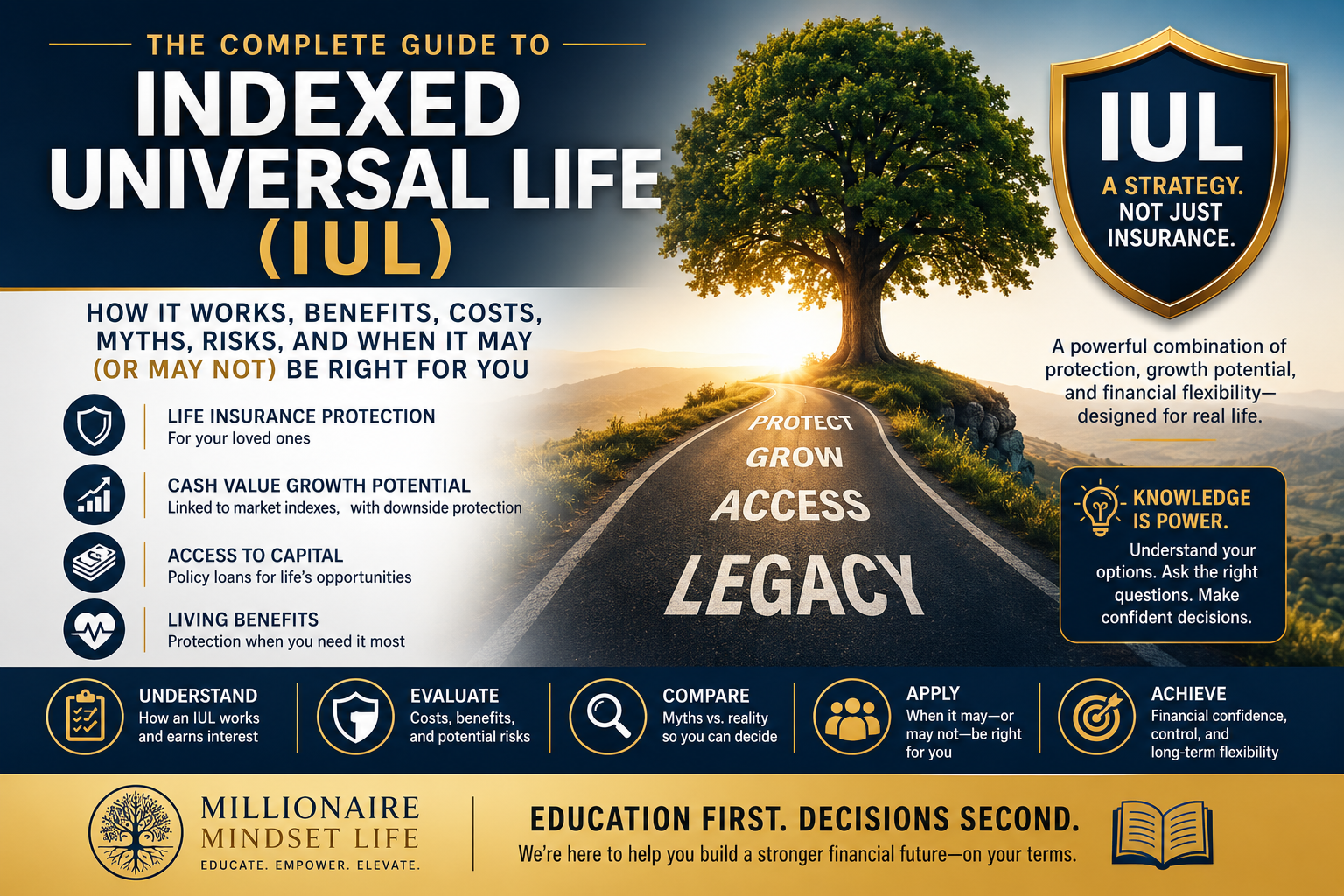
An Educational Guide to Understanding One of the Most Discussed(and Most Misunderstood) Financial Strategies Available Today. How It Works, Common Myths, Costs, Benefits, Risks, and When It May (or May Not) Be Right for You
Why There Is So Much Confusion Around IULs
Few financial strategies create as much discussion, debate, and misunderstanding as Indexed Universal Life insurance, commonly known as an IUL.
Some people believe IULs are one of the most powerful financial tools available. Others believe they are too expensive, too complicated, or too good to be true. The reality is that much of the confusion comes from incomplete information, unrealistic expectations, or a lack of understanding about how these policies actually work.
As financial coaches, we often see people evaluating an IUL through the lens of an investment, a savings account, or a retirement plan. While an IUL can share characteristics with each of those financial vehicles, it is none of them exclusively.
An IUL is first and foremost a life insurance contract.
Understanding that distinction is critical because it changes how the policy should be evaluated, funded, and used.
The purpose of this guide is not to convince you that an IUL is right for you.
The purpose is to help you understand:
• What an IUL is
• How it works
• How interest is credited
• How policy loans function
• What costs and fees exist
• Common myths and misconceptions
• Situations where an IUL may not be appropriate
• Questions you should ask before purchasing any policy
Our philosophy is simple:
Education first. Decisions second.
The more you understand how a strategy works, the more confident you can be in determining whether it belongs in your financial plan.
What Is an Indexed Universal Life (IUL)?
An Indexed Universal Life policy is a form of permanent life insurance that combines two primary components:
- Life insurance protection
- Cash value accumulation
Unlike term insurance, which provides protection for a specific period of time, an IUL is designed to provide lifelong coverage as long as policy requirements are met.
A portion of each premium you pay goes toward maintaining the life insurance protection. Another portion may accumulate inside the policy as cash value.
Over time, that cash value has the potential to grow based on the performance of selected market indexes.
This is where many people become confused.
The policy is linked to market indexes, but your money is not directly invested in those indexes.
This distinction is important.
When you invest directly into the stock market, your account value rises and falls based on market performance.
An IUL operates differently.
The insurance company uses a crediting methodology that allows policyholders to participate in some of the upside potential of selected indexes while also providing protection from direct market losses.
Because of this design, many people view an IUL as a unique combination of:
• Protection
• Growth potential
• Tax advantages
• Access to capital
• Long-term financial flexibility
However, it is important to remember that an IUL is not an investment account pretending to be insurance.
It is an insurance policy with additional features that may create financial opportunities when used properly.
How Does an IUL Actually Work?
One of the easiest ways to understand an IUL is to follow the path of a premium payment.
Imagine you contribute premium into your policy.
That premium typically flows through several stages:
Step 1: Premium Deposit
You make a premium contribution into the policy.
Depending on the policy structure, some charges may be deducted before the remaining amount moves into the cash value portion of the contract.
Step 2: Insurance Protection
A portion of the premium helps pay for the life insurance protection provided by the policy.
This is commonly referred to as the Cost of Insurance (COI).
The COI is influenced by factors such as:
• Age
• Gender
• Health rating
• Death benefit amount
• Policy design
Generally speaking, younger and healthier individuals tend to have lower insurance costs.
Step 3: Cash Value Accumulation
After applicable charges and insurance costs are addressed, remaining dollars may accumulate within the policy’s cash value account.
This is the portion of the policy that has the potential to grow over time.
Step 4: Interest Crediting
The cash value receives interest based on the performance of selected index strategies available within the contract.
The amount credited depends on factors such as:
• Participation rates
• Cap rates
• Spreads
We will discuss each of these in greater detail later in this guide.
Step 5: Growth and Access
As cash value accumulates, policyholders may eventually have access to that value through withdrawals or policy loans, depending on the structure and status of the policy.
Many advanced strategies—including “Be Your Own Bank” concepts—are built around understanding how this access to capital works.
Example
Imagine a policyholder contributes premium consistently over many years.
The policy provides life insurance protection from day one.
At the same time, cash value begins accumulating inside the policy.
Over time, interest credits may increase the cash value.
As the cash value grows, the policyholder may gain additional flexibility and access to capital while maintaining life insurance protection.
This combination of protection, accumulation, and access is what makes IULs different from many traditional financial vehicles.
How Does an IUL Earn Interest?
One of the most attractive features of an Indexed Universal Life policy is how interest is credited to the cash value.
Many people hear the phrase “linked to the market” and assume the policy functions like a stock market investment account.
That is not how an IUL works.
Instead, the insurance company uses the performance of selected indexes as a measuring tool to determine how much interest may be credited to the policy.
Common indexes available within IUL contracts may include:
• S&P 500
• Nasdaq-linked strategies
• Multi-asset indexes
• Volatility-controlled indexes
• Proprietary institutional indexes
It is important to remember that your money is not directly invested into these indexes.
Rather, the insurance company uses a crediting formula that references index performance.
Several factors influence how much interest may ultimately be credited.
Participation Rates
A participation rate determines how much of an index gain you participate in.
For example:
If an index gains 10% and the participation rate is 80%, the credited interest may be 8%.
The participation rate allows the policyholder to participate in a portion of the index performance while still maintaining downside protection.
Cap Rates
Some index strategies use a cap.
A cap establishes the maximum amount of interest that may be credited during a measurement period.
For example:
If the cap is 10% and the index gains 15%, the credited amount would typically be limited to 10%.
Spreads
Some strategies use a spread rather than a cap.
A spread is deducted from the index gain before interest is credited.
Example:
Index Gain = 10%
Spread = 3%
Credited Interest = 7%
Different Index Strategies
Many modern IULs provide multiple index options.
Some focus on traditional stock market benchmarks.
Others utilize institutional-style indexes that seek to manage volatility through diversification and risk controls.
This allows policyholders to select strategies that align with their goals and preferences.
Understanding the 0% Floor
One of the most frequently discussed features of an IUL is the 0% floor.
This feature is often misunderstood.
Let’s start with what it means.
A 0% floor generally means that if the selected index experiences negative performance during a measurement period, the policy is not credited with a negative interest rate due to that index performance.
In simple terms:
If the index is down 20%, your policy is not credited with -20%.
Instead, the credited interest may be 0%.
What the Floor Does
The floor is designed to protect policyholders from direct market losses associated with the selected index strategy.
This is one reason many individuals find IULs attractive compared to directly investing in volatile markets.
What the Floor Does NOT Do
A common misconception is that a 0% floor guarantees the policy will never experience challenges.
That is not accurate.
While market losses may not be directly credited to the policy, insurance costs and policy expenses continue to exist.
If a policy experiences prolonged periods of low interest crediting and insufficient funding, policy performance may still be impacted.
The Trade-Off
Every financial strategy involves trade-offs.
In exchange for downside protection, policyholders may give up some upside potential through participation rates, caps, or spreads.
This creates a different risk-and-reward profile than direct market investing.
For many individuals, that trade-off is attractive.
For others, maximum market participation may be more important.
Neither approach is inherently right or wrong.
The appropriate choice depends on individual goals, risk tolerance, and financial circumstances.
Understanding Policy Loans and Access to Capital
One of the most unique aspects of an IUL is the ability to access cash value while keeping the policy in force.
This is also one of the most misunderstood concepts.
When people hear that policyholders can access cash value, they often assume the money must be withdrawn from the policy.
That is only one option.
Withdrawals
A withdrawal removes money directly from the policy.
This may reduce:
• Cash value
• Death benefit
• Future growth potential
Depending on policy design and circumstances, withdrawals may have long-term consequences that should be carefully evaluated.
Policy Loans
Most advanced IUL strategies utilize policy loans rather than withdrawals.
With a policy loan, the policyholder borrows against the policy’s cash value.
The insurance company provides access to capital while the policy remains in force.
This distinction is important because the cash value may continue participating in interest-crediting strategies while the loan remains outstanding, depending on the policy and loan provisions.
Understanding Loan Rates
Insurance companies charge interest on policy loans.
The loan rate varies by carrier and policy design.
Many people focus exclusively on the loan interest rate.
However, experienced policy owners often evaluate both sides of the equation:
• What is being charged?
• What is being credited?
The difference between those two figures is often referred to as the spread.
Example
Assume:
Loan Rate = 5.5%
Interest Credited = 6.0%
The difference between the two is 0.5%.
This concept forms the foundation of many “Be Your Own Bank” discussions.
Why This Matters
Access to capital can provide flexibility during life events, business opportunities, real estate purchases, emergencies, or retirement.
Rather than liquidating assets and potentially interrupting long-term growth strategies, policyholders may have an additional source of accessible capital.
Of course, loans must be managed responsibly.
Unmanaged policy loans can negatively impact policy performance and may create unintended consequences.
Proper design, funding, and ongoing management are critical.
Living Benefits: Protection While You’re Alive
When most people think about life insurance, they think about a death benefit.
In other words, they think about money being paid to beneficiaries after the insured passes away.
While that is certainly an important part of life insurance, many modern policies include additional features designed to provide benefits while the insured is still living.
These are commonly referred to as Living Benefits.
Living Benefits have become one of the most significant advancements in the life insurance industry because they address a financial risk that many families overlook.
The risk is not simply dying too soon.
The risk is experiencing a serious health event that impacts your ability to earn an income while increasing your expenses.
What Are Living Benefits?
Living Benefits are policy riders that may allow the policyholder to access a portion of the death benefit if a qualifying health event occurs.
Depending on the policy, qualifying events may include:
• Terminal illness
• Chronic illness
• Critical illness
Each carrier has its own definitions, eligibility requirements, and rider provisions.
Why Are Living Benefits Important?
Life rarely follows a perfect plan.
A serious health event can create financial challenges very quickly.
Income may decrease or stop altogether.
Medical expenses may increase.
Family responsibilities continue.
Mortgage payments still come due.
Bills still arrive.
The financial pressure created by a health event can sometimes be more damaging than the illness itself.
Living Benefits are designed to provide access to resources during those situations.
Two Different Types of People Often Benefit
1. Individuals Who Have Already Built Assets
For individuals who have accumulated retirement accounts, investment portfolios, businesses, or real estate, Living Benefits can serve as a financial hedge.
Rather than being forced to liquidate assets during a difficult time, they may have access to policy benefits that help preserve their long-term strategy.
Living Benefits may help reduce the need to:
• Sell investments
• Liquidate retirement assets
• Disrupt income plans
• Abandon long-term goals
2. Individuals Who Are Still Building Assets
For those still in the accumulation phase of life, Living Benefits can serve as a financial safety net.
A serious health event can quickly create financial chaos.
Income may stop.
Expenses may rise.
Savings may disappear.
In these situations, Living Benefits may provide resources that help families maintain stability during difficult circumstances.
What Does an IUL Actually Cost?
One of the most common questions people ask is:
“What are the fees?”
That is an important question.
Every financial vehicle has costs.
The goal is not to find a strategy with no costs.
The goal is to understand:
• What the costs are
• Why they exist
• How they behave over time
Let’s break down the primary costs associated with many IUL policies.
Cost of Insurance (COI)
The Cost of Insurance represents the expense associated with providing life insurance protection.
Several factors influence this cost:
• Age
• Gender
• Health classification
• Death benefit amount
• Policy design
Generally speaking, younger and healthier individuals tend to have lower insurance costs than older individuals or those with significant health concerns.
Premium Expense Charges
Some policies apply a charge to premium deposits.
This means that a portion of each premium may be allocated toward policy expenses before entering the cash value account.
Depending on the carrier and policy design, these charges may:
• Decline over time
• End after certain years
• Continue throughout the life of the contract
Administrative Fees
Most policies include administrative charges designed to support policy administration and maintenance.
These charges vary by carrier and product.
Additional Expense Charges
Certain policies may include additional charges related to policy features, riders, or specific contract provisions.
Understanding these charges is an important part of evaluating any policy.
Surrender Charges
Most IULs are designed to be long-term financial assets.
Because of this, many contracts include surrender schedules.
A surrender charge may apply if a policy is terminated during the early years.
Typically, surrender charges:
• Begin at their highest level during early years
• Decline over time
• Eventually expire
This is one reason IULs are generally not considered short-term financial vehicles.
Why Fees Matter
Many consumers focus only on whether a fee exists.
A better question is:
How does the fee behave over time?
That leads us to one of the most important concepts in understanding IUL design.
The Long-Term Design Advantage
One of the most overlooked aspects of an IUL is how many policy expenses behave over time.
Many people evaluate a policy during its early years and assume that the early-year experience will continue indefinitely.
That is often not the case.
The Early Years
During the early years, policies are being established.
Various charges, expenses, and costs are typically more noticeable.
As a result, cash value growth may appear slower than many people expect.
This is normal.
The policy is still in its foundation-building stage.
The Middle Years
As the policy matures:
• Certain charges may decline
• Surrender charges continue to decrease
• Cash value accumulation may become more significant
• Compound growth has more time to work
This is often where the long-term design of the policy begins to become more apparent.
The Long-Term Years
Over longer periods of time, many policies experience a shift in the relationship between costs and assets.
While cash value may continue growing, certain expenses may decrease or disappear.
This creates a dynamic that many people find attractive.
A Different Fee Dynamic
Many traditional financial accounts utilize asset-based fee structures.
As account values increase, the fees paid may also increase because they are calculated as a percentage of the growing account balance.
An IUL often behaves differently.
When properly designed and funded:
• Certain expenses decline
• Certain charges disappear
• Assets may continue growing
In simple terms:
You may have a decreasing fee schedule on an increasing asset.
This does not mean costs disappear entirely.
Nor does it guarantee future performance.
However, it does represent a structural characteristic that many consumers never fully understand.
Why Proper Design Matters
Not all IULs are designed the same.
Two policies from different carriers can produce dramatically different outcomes.
Factors such as:
• Funding strategy
• Carrier selection
• Index choices
• Loan provisions
• Long-term management
all influence the policy’s effectiveness.
This is why education, planning, and proper implementation matter.
Common IUL Myths vs. Reality
Few financial products are surrounded by more misinformation than Indexed Universal Life insurance.
Some of that misinformation comes from unrealistic marketing.
Some comes from misunderstanding.
And some comes from evaluating an IUL as something it was never intended to be.
Let’s examine some of the most common myths.
Myth #1: An IUL Is an Investment
Reality:
An IUL is a life insurance contract.
While it contains a cash value component that has the potential to grow, it is not a stock, mutual fund, ETF, or brokerage account.
The policy uses market indexes as a reference for interest crediting, but policyholders are not directly investing in those indexes.
Understanding this distinction helps set realistic expectations from the beginning.
Myth #2: IULs Have No Fees
Reality:
Every financial vehicle has costs.
Brokerage accounts have costs.
Mutual funds have costs.
Annuities have costs.
Real estate has costs.
Life insurance has costs.
The question is not whether fees exist.
The question is:
• What are they?
• How do they behave?
• What value are they providing?
An educated consumer should understand the fee structure before making any financial decision.
Myth #3: An IUL Makes Everyone Rich
Reality:
No financial product creates wealth by itself.
An IUL is a tool.
The results depend on:
• Proper design
• Proper funding
• Consistent implementation
• Long-term management
Just as a hammer can build a house or sit unused in a garage, the effectiveness of an IUL depends on how it is used.
Myth #4: All IULs Are the Same
Reality:
Carrier selection matters.
Policy design matters.
Funding strategy matters.
Loan provisions matter.
Index options matter.
Two policies may both be called IULs while producing dramatically different long-term outcomes.
This is one reason proper education and planning are so important.
Myth #5: Market Crashes Will Destroy My Policy
Reality:
Most IULs include a floor designed to protect policyholders from direct market losses associated with index performance.
That does not mean policies cannot face challenges.
However, negative market performance generally does not result in negative interest crediting.
Myth #6: I Can Put Money In Today and Take It Out Tomorrow
Reality:
IULs are long-term financial assets.
Many of the advantages associated with an IUL require time.
Attempting to use a long-term strategy as a short-term solution often leads to disappointment.
The Bigger Reality
The truth is that an IUL is neither as good as its biggest supporters claim nor as bad as its biggest critics suggest.
Like any financial tool, it has strengths.
It has limitations.
It has appropriate uses.
And it has situations where other solutions may be more appropriate.
When an IUL May NOT Be Right for You
One of the most important things a financial coach can do is help someone understand when a strategy is not a good fit.
An IUL is not designed for everyone.
And that’s okay.
The goal is not to force every solution to fit every person.
The goal is to identify the right solution for the right situation.
An IUL May Not Be Right If…
You Need Short-Term Liquidity
IULs are generally designed for long-term planning.
If you expect to deposit money today and need unrestricted access tomorrow, other solutions may be more appropriate.
You Are Looking for Quick Returns
The greatest strengths of an IUL often emerge over years and decades.
Individuals seeking short-term performance may become frustrated with the timeline required.
You Want Maximum Market Exposure
The downside protection built into many IULs comes with trade-offs.
Those seeking maximum market participation may prefer direct investment strategies.
You Cannot Consistently Fund the Policy
Like many financial strategies, consistency matters.
Policies that are significantly underfunded often struggle to achieve their intended objectives.
You Have No Need for Life Insurance
Life insurance protection is the foundation of the strategy.
If protection is not important to your financial plan, other vehicles may deserve consideration.
You Do Not Intend to Keep It Long Term
Many of the benefits associated with IULs require time.
Individuals unwilling to commit to a long-term approach may find better alternatives elsewhere.
The Right Tool for the Right Job
A quality financial plan is not built around products.
It is built around goals.
Sometimes an IUL helps accomplish those goals.
Sometimes another strategy is more appropriate.
The key is understanding the difference.
Who Is an IUL Often Best Suited For?
While an IUL is not right for everyone, there are situations where it may provide meaningful value.
Long-Term Thinkers
Individuals who understand the importance of patience and long-term planning often appreciate the structure of an IUL.
The strategy rewards consistency and time.
Families Seeking Protection and Growth
Many families want more than just life insurance.
They want:
• Protection
• Accumulation potential
• Access to capital
• Financial flexibility
An IUL may provide all four within a single strategy.
Professionals and Business Owners
Business owners and professionals often appreciate the flexibility associated with cash value accumulation and policy loans.
Access to capital can be valuable when opportunities or unexpected needs arise.
Individuals Seeking Tax-Advantaged Accumulation
Many people are concerned about future tax uncertainty.
An IUL may offer opportunities for tax-advantaged accumulation and access when structured and managed properly.
People Interested in Future Income Flexibility
Many retirement plans focus exclusively on asset accumulation.
An IUL can introduce additional flexibility by creating another potential source of future income and capital access.
Individuals Interested in Financial Control
Some people simply want more control over how their money is stored, accessed, and utilized.
This desire for control often leads people to explore concepts such as:
• Cash flow management
• Policy loans
• Private financing
• Be Your Own Bank strategies
The Common Thread
The people who tend to benefit most from an IUL are not necessarily seeking the highest possible return.
They are often seeking a combination of:
• Protection
• Growth
• Flexibility
• Access
• Control
Questions to Ask Before Purchasing Any IUL
One of the greatest mistakes consumers make is purchasing a financial product before fully understanding how it works.
This is especially true with Indexed Universal Life insurance.
The good news is that you don’t need to become an insurance expert.
You simply need to ask better questions.
The quality of your questions often determines the quality of your decisions.
Whether you’re considering an IUL, retirement account, annuity, investment account, or any other financial strategy, understanding the details matters.
Here are some important questions to ask before purchasing any IUL.
What Is the Primary Purpose of This Policy?
Every policy should have a clearly defined objective.
Is the primary purpose:
• Family protection?
• Cash value accumulation?
• Future retirement income?
• Business planning?
• Legacy planning?
• Access to capital?
The design of the policy should support its intended purpose.
How Is the Policy Being Funded?
Funding strategy often has a greater impact on long-term performance than the policy itself.
Ask:
• How much premium is being contributed?
• For how long?
• Is the policy being minimally funded or maximally funded?
• What assumptions are being used?
Understanding the funding strategy helps establish realistic expectations.
What Costs and Charges Exist?
Consumers should understand:
• Cost of insurance
• Premium charges
• Administrative fees
• Rider costs
• Surrender schedules
Remember:
The objective is not finding a policy with no costs.
The objective is understanding how costs behave over time and what value they provide.
What Index Strategies Are Available?
Not all index options are the same.
Ask:
• What indexes are available?
• How do participation rates work?
• Are there caps?
• Are there spreads?
• How have the strategies historically behaved?
While past performance does not guarantee future results, understanding the mechanics is important.
How Do Policy Loans Work?
If future access to capital is important, loan provisions deserve careful review.
Ask:
• What loan options are available?
• What are the loan rates?
• How does the company credit interest while loans are outstanding?
• What are the long-term implications of policy loans?
Understanding policy loans is critical for anyone interested in future flexibility or “Be Your Own Bank” concepts.
What Happens Under Different Scenarios?
One of the most valuable exercises is stress testing assumptions.
Ask:
• What happens if returns are lower than illustrated?
• What happens if I stop funding the policy?
• What happens if I take loans?
• What happens if I live longer than expected?
A quality advisor should be willing to discuss multiple scenarios—not just the best-case outcome.
Is This the Right Tool for My Situation?
Perhaps the most important question is:
“Is this actually the best solution for my goals?”
Sometimes the answer is yes.
Sometimes the answer is no.
The right recommendation should be driven by your objectives, not by a product.
Education First. Decisions Second.
Indexed Universal Life insurance is one of the most discussed…and often misunderstood—financial strategies available today.
For some individuals and families, it can provide a unique combination of:
• Life insurance protection
• Tax-advantaged accumulation
• Access to capital
• Living benefits
• Long-term financial flexibility
For others, it may not be the most appropriate solution.
The reality is that no financial strategy is perfect.
Every strategy involves trade-offs.
Every strategy has strengths.
Every strategy has limitations.
The key is understanding where those strengths and limitations fit within your overall financial plan.
As we’ve explored throughout this guide:
• An IUL is not an investment.
• It is a life insurance contract.
• Interest is credited differently than traditional investments.
• Costs exist and should be understood.
• Policy loans create unique opportunities and responsibilities.
• Living benefits can provide protection during life’s most difficult moments.
• Proper design and funding matter.
• Not every policy is the same.
• Not every person is a good fit.
Most importantly, financial decisions should never be based solely on marketing claims, social media opinions, or sales presentations.
They should be based on education.
The more you understand how a strategy works, the more confidence you can have in deciding whether it belongs in your financial future.
Your Next Step
If you’d like to continue your education, we invite you to explore two free resources:
Skeptical Questions to Ask Before Buying an IUL
A consumer-focused guide designed to help you ask better questions, avoid common misconceptions, and make more informed decisions.
Learn how many families are exploring concepts related to cash flow, capital access, financing, and taking a more active role in their financial system.
Remember:
Education first. Decisions second.
The goal isn’t to buy a product.
The goal is to understand your options well enough to make the best decision for your unique situation.
Disclaimer
This article is intended for educational purposes only and should not be considered tax, legal, investment, or financial advice. Policy features, costs, riders, loan provisions, and benefits vary by carrier and policy design. Individuals should consult qualified professionals regarding their specific circumstances before making financial decisions.
This article is for general educational purposes only and is not tax, legal, accounting, or investment advice. Strategies depend on individual circumstances and current law. Please review any strategy with your CPA, tax attorney, or other qualified professional before acting. Insurance products are subject to underwriting and carrier terms.