The Quiet Cycle of Debt, Power, and the Rotation of Global Capital
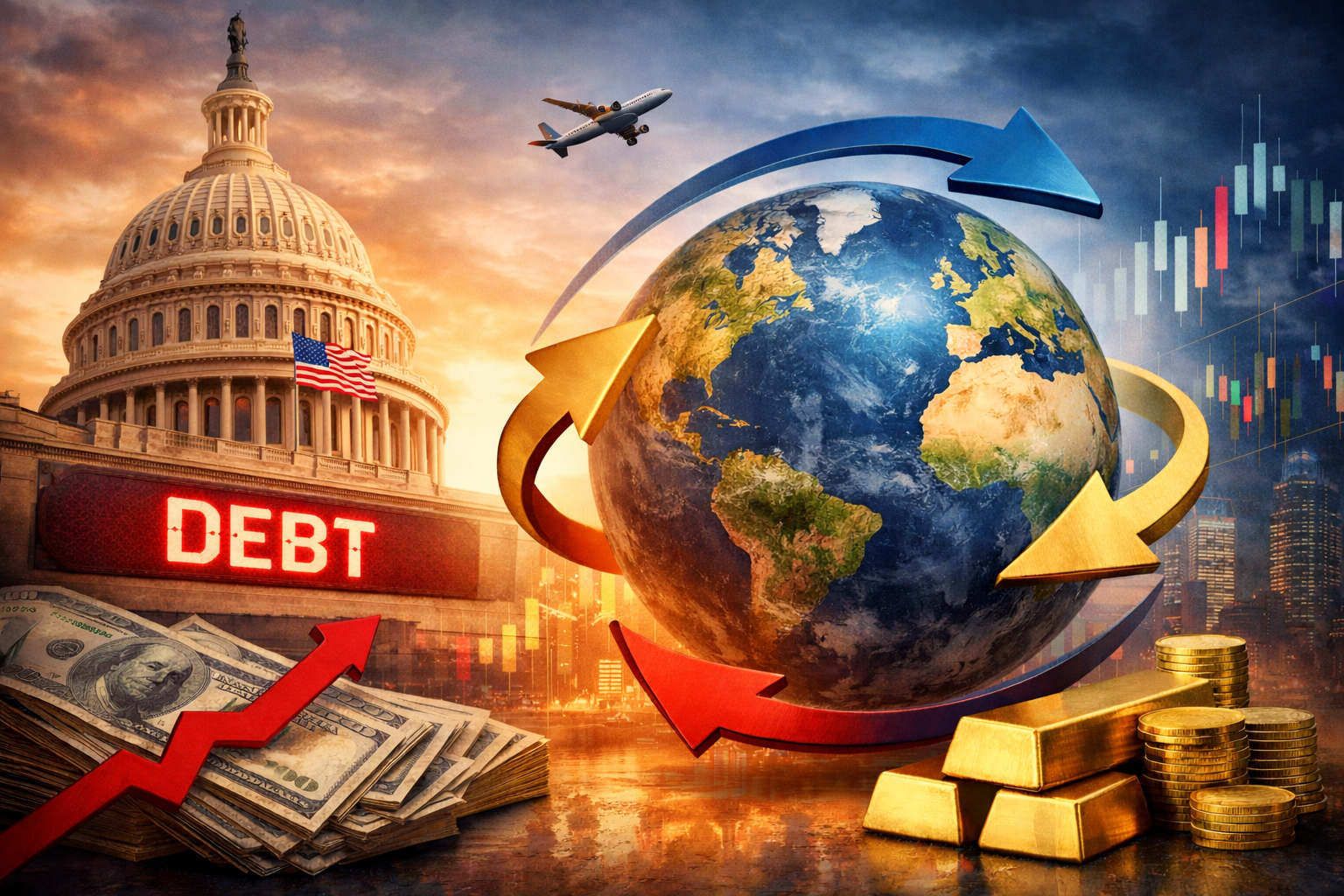
The U.S. is approaching $40 trillion in debt…not a projection, not a political soundbite, but the number expected to be on the books n the near future.
Most people hear a number that big and mentally file it away as “government stuff.” Too large to understand. Too distant to matter.
But history shows something very different: when debt reaches a certain point, it doesn’t just sit there…it forces the system to change. And those changes don’t show up first in headlines. They show up first in capital flows; in what institutions do quietly, long before the public recognizes the pattern.
Because this isn’t just about debt.
It’s about what debt makes the machine do next.
Debt Isn’t the Problem, It’s the Signal
The debt number itself isn’t the whole issue. The issue is what that number forces:
Greater pressure to create money
Higher interest rates and refinancing risk
More reliance on cash flow
Greater sensitivity to rate changes
Less policy flexibility as interest costs rise
And when those pressures reach a certain intensity, something predictable happens: the people and institutions who actually read balance sheets—who see risk as math, not opinion—begin to move.
Quietly.
Not with a press conference. Not with panic. With rebalancing.
The Four-Stage Cycle That Keeps Repeating
Over the last 500 years, global financial powers have tended to follow the same broad sequence; whether it’s an empire, a reserve currency, or a banking center.
1) The Rising Phase
A nation becomes the epicenter of global finance.
Its currency is trusted. Capital flows in. Markets deepen. Innovation accelerates. Confidence feels indestructible.
This phase can last decades. Long enough for people to believe it will last forever.
2) The Overextension Phase
Success breeds complacency.
Government spending expands. Debt becomes a tool to fund wars, domestic promises, and global influence. Asset prices rise, often faster than the real economy. Central banks become the “solution” to every major shock.
It becomes normal.
And that’s exactly why it’s dangerous.
3) The Stealth Evacuation (Quiet Rotation)
This is the critical stage…and it’s the one most people miss.
The “smart money” doesn’t wait for confirmation. Institutions don’t need headlines to act. They reduce concentrated exposure and increase diversification. Slowly at first, then faster as trust begins to weaken.
It looks like “normal diversification”…until it doesn’t.
4) The Reset / Collapse Phase
Eventually, the system is forced into a decision it can’t make cleanly:
Defend the currency with higher rates and spending cuts
or
Protect the financial system with easier money and higher inflation
Both have consequences.
And the group hit first (almost every time) is the middle class, because their wealth tends to be concentrated in domestic assets that reprice or erode.
“History Doesn’t Repeat” But Incentives Do
People love to debate whether the present is unique. And of course, every era has differences.
But cycles aren’t powered by identical events.
They’re powered by incentives.
When incentives and constraints line up the same way, outcomes rhyme—even if the details change.
The transcript points to three historical examples that followed the same “shape”:
Spain (1500s): wealth inflows, ballooning spending, rising debt, defaults
Netherlands / Amsterdam: global finance hub, war costs, debt strain, capital migration
Britain / the Pound: reserve currency dominance, expensive wars, gradual loss of reserve status as power shifted to the U.S.
Each example wasn’t a movie-style collapse overnight.
It was a transition. A rotation. A slow change in trust and capital allocation.
Where the U.S. Fits in the Cycle
After World War II, the U.S. clearly entered the rising phase:
The dollar anchored global trade
U.S. markets became the deepest and most liquid in the world
The world needed dollars to transact and store value
Over time, the U.S. drifted into overextension:
Persistent deficits
Expanding debt loads
Growing dependence on refinancing
Widespread belief that the central bank can “fix” any crisis
And today, the argument is that we’re seeing early signs of Stage 3…the quiet rotation.
Not because “America is done,” but because global investors respond to a changing risk-reward equation.
Stage 3 Doesn’t Require the Dollar to “Die”
This is the part most people get wrong.
The dollar doesn’t need to vanish for Stage 3 to happen.
Stage 3 can look like:
Gradual shifts in foreign holdings of Treasuries
Increasing trade settlement in non-dollar currencies
Rising gold accumulation by central banks
More open discussion of international allocation by major funds
Experiments in alternative commodity settlement
These are not “end of the world” signals.
They’re hedging signals.
And small changes matter when you’re talking about the global reserve system, because reserve dominance is a game of percentages, not absolutes.
Why Stage 3 Is So Dangerous
Because it doesn’t feel like a crisis.
It feels like:
A weird market
Choppy headlines
Constant narrative shifts
A world that’s “changing” without an obvious breaking point
But beneath the surface, the plumbing changes:
When foreign buyers step back from Treasuries, someone else must absorb the supply. If domestic buyers don’t step in aggressively, yields rise. Higher yields raise borrowing costs across the economy; mortgages, corporate debt, consumer loans.
That slows growth, pressures profits, and reprices assets.
Meanwhile, the government’s interest bill rises, worsening deficits, driving even more issuance.
Add weakening currency confidence and you get:
Higher import costs
More inflation pressure
Tighter financial conditions
That’s how Stage 4 begins…not with a single event, but with loops that reinforce each other.
What Should a Normal Person Do With This?
Not panic. Not ignore it.
Position.
The transcript’s core recommendation is simple: understand your exposure, reduce single points of failure, and build resilience.
Here are the practical ideas outlined:
1) Know Your Exposure
Most people are overexposed without realizing it:
Salary in dollars
Savings in dollars
Retirement accounts in dollar-based markets
Home priced in dollars
Debts owed in dollars
If purchasing power erodes, it touches everything.
2) Diversify Like It Actually Matters
Not “15 tech stocks.”
Real diversification means across:
Asset classes
Geographies
Risk profiles
3) Consider Real Assets
Assets that are scarce and can’t be printed have historically held value across transitions.
Gold is the obvious example, but the broader idea is hard-to-dilute assets.
4) Maintain Liquidity
Cash loses value in inflationary environments…but liquidity provides options. Options matter most during transitions because opportunities show up fast.
5) Reduce Fragile Leverage
Debt isn’t always bad, but fragile debt is dangerous when rates rise and volatility increases, especially variable-rate obligations and high-interest consumer balances.
6) Invest in Skills and Relationships
This sounds “motivational,” but it’s also practical:
Skills produce income in any system
Networks create opportunities when conditions tighten
7) Stay Informed Without Losing Your Mind
The two traps are:
doom addiction
total avoidance
Neither builds strength.
The goal is information + positioning, not fear.
The Real Threat Isn’t Collapse, It’s Erosion
Most monetary stress doesn’t look like a dramatic movie scene.
It looks like:
your income not keeping up
your savings buying less
your portfolio growing on paper while shrinking in real terms
That’s how many people experience “system change.”
Not chaos…erosion.
Final Thought: Math Doesn’t Need Permission
Empires tell themselves stories. Systems maintain confidence…until the math forces different decisions.
The key takeaway from the transcript is not political and not conspiratorial:
Debt changes incentives. Incentives change behavior. Behavior changes outcomes.
And the people who benefit most in transitions are rarely the ones waiting for mainstream confirmation.
They’re the ones who saw the phase early and positioned accordingly.
Disclaimer: The information provided in this article is for general educational purposes only and does not constitute financial, tax, investment, or legal advice. Individual circumstances vary, and you should consult with a licensed professional before making any financial decisions.
This article is for general educational purposes only and is not tax, legal, accounting, or investment advice. Strategies depend on individual circumstances and current law. Please review any strategy with your CPA, tax attorney, or other qualified professional before acting. Insurance products are subject to underwriting and carrier terms.