What Happens When Income Stops?
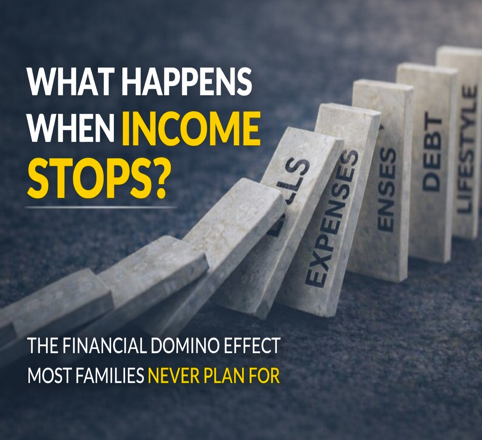
The Financial Domino Effect Most Families Never Plan For
Every household runs on a financial engine.
That engine is income.
Income fuels nearly every part of daily life:
- Mortgage or rent payments
- Groceries and utilities
- Transportation
- Insurance
- Debt obligations
- Children’s expenses
- Savings and investments
Most financial plans quietly assume one thing:
Income will continue uninterrupted.
But life rarely follows perfect assumptions.
Illness, accidents, job loss, disability, and even premature death can interrupt income without warning. When that happens, the question is no longer theoretical.
The real question becomes:
What happens when income stops?
For many households, the answer begins almost immediately.
The Moment Income Stops
When income disappears (whether partially or completely) the financial system of a household begins to feel the pressure quickly.
Bills do not pause.
Mortgage payments still arrive.
Utilities still need to be paid.
Credit cards still accumulate interest.
Most families feel the financial impact within weeks, sometimes even days.
Income disruption can occur for a number of reasons:
A serious illness or medical diagnosis
Disability or injury that prevents work
Job loss or layoffs
Long-term medical treatment
Accidents
Premature death of an income earner
These are not rare events. They are real-life risks that every household faces at some point.
And when income stops, families tend to fall into one of two categories.
Two Types of Financial Outcomes
1. The Household With Assets
Some families have built a financial foundation through savings, investments, retirement accounts, or other assets.
At first glance, this appears to provide protection.
But when income stops, something else begins to happen.
Those assets (originally meant for the future) are now forced into service for the present.
Money intended for:
Retirement
Long-term investing
Wealth accumulation
Education planning
Now becomes:
Mortgage payments
Household bills
Medical costs
Debt obligations
In other words, future wealth begins getting consumed by present survival.
This can create several long-term consequences:
Early withdrawals from retirement accounts
Taxes and penalties on distributions
Selling investments at unfavorable times
Destroying compounding growth
Assets that were meant to secure the future end up protecting the present instead.
While this may solve the immediate problem, it often permanently damages long-term financial plans.
2. The Household Without Assets
For families without significant savings or reserves, the timeline moves much faster.
Without income and without assets, the system begins to break down quickly.
The pattern is unfortunately common.
First, bills start falling behind.
Then credit cards are used to fill the gap.
Debt grows rapidly.
Interest compounds.
Eventually the pressure becomes overwhelming.
This begins a cascading motion of financial chaos, often including:
Missed payments
Collections
Credit damage
Asset repossession
Bankruptcy
Foreclosure
These situations rarely happen overnight, but once the cycle begins it can be extremely difficult to stop.
The emotional and financial stress on families can be enormous.
Why Most People Avoid This Conversation
Talking about income disruption forces people to think about uncomfortable realities:
Illness
Disability
Financial vulnerability
Mortality
Because these topics are difficult, many people choose to simply avoid them.
Unfortunately, ignoring a risk does not eliminate it.
It only removes preparation for the consequences.
Financial planning is not about hoping the worst never happens.
It is about ensuring that if something does happen, the people we care about are protected.
Risk Management Is Part of Every Smart Financial Plan
Every major financial system in the world includes risk management.
Businesses hedge risk.
Investors hedge risk.
Banks hedge risk.
Yet many households leave the most important financial variable completely exposed…
their income.
Income is the foundation that supports everything else.
Without income, the entire structure becomes unstable.
Protecting income is not pessimistic planning.
It is responsible financial design.
The Hedge: Income Protection Through Term Insurance With Living Benefits
Fortunately, protecting income does not require complicated strategies.
There is a simple and cost-effective solution designed specifically for this purpose:
Term life insurance with living benefits.
This type of coverage provides protection not only in the event of death but also during certain life-altering events such as:
Critical illness
Chronic illness
Terminal illness
Certain disability situations
These living benefits allow access to funds while the policyholder is still alive if a qualifying event occurs.
This financial protection can be used to help cover:
Mortgage payments
Household bills
Medical costs
Debt obligations
Income replacement
Instead of assets being drained or financial chaos beginning, the insurance policy acts as a financial shock absorber.
It buys time.
It creates options.
And most importantly, it protects the stability of the household.
Mortgage Protection and Family Stability
For many families, the largest financial obligation they carry is their home.
The mortgage represents both:
The largest monthly expense
The largest asset most families own
Mortgage protection strategies ensure that if income stops unexpectedly, the family’s home does not immediately become at risk.
Maintaining housing stability during difficult times can prevent a temporary crisis from becoming a permanent financial setback.
Protecting the home protects the entire financial structure of the family.
The Real Value: Peace of Mind
Insurance is often misunderstood.
It is not about expecting the worst.
It is about protecting against the financial consequences of the worst.
When structured properly, income protection strategies provide:
Financial stability
Time to recover
Options during difficult circumstances
Peace of mind for families
The goal is not fear.
The goal is preparedness.
Responsible Planning Protects the Future
No one enjoys thinking about worst-case scenarios.
But responsible financial planning requires looking at risks honestly and preparing accordingly.
A relatively small hedge today can prevent devastating financial consequences tomorrow.
Protecting income is one of the most important steps a family can take to secure their financial future.
Because when income stops, the effects can begin immediately.
The question is not whether life can throw unexpected challenges our way.
The real question is whether we will be prepared when it does.
Want to Learn More?
If you would like to understand:
How income protection works
What level of coverage may be appropriate for your household
How to structure mortgage and income protection efficiently
You can grab our Free Mortgage Protection Made Simple Guide and explore strategies designed to help protect your home, your income, and your family’s financial future.
Preparation today can create peace of mind for years to come.
This article is for general educational purposes only and is not tax, legal, accounting, or investment advice. Strategies depend on individual circumstances and current law. Please review any strategy with your CPA, tax attorney, or other qualified professional before acting. Insurance products are subject to underwriting and carrier terms.