
Tax Filing vs. Tax Planning: The 20-Year Cost of Simply Writing the Check
For business owners and high earners, taxes can be one of the largest expenses they face over a lifetime. Yet despite the amount of money involved, many people don’t really plan for taxes. Instead, they gather their documents, send everything to their CPA, receive the number, write the check, and repeat the process the following year.
There is nothing wrong with tax preparation. Accurate filing and compliance are essential. But tax preparation and proactive tax planning are two very different things and over 5, 10, 15 or 20+ years, that difference can potentially become enormous.
Two Business Owners. One Important Difference.
Imagine two successful business owners with similar businesses, incomes, lifestyles and financial goals. For illustration, assume each would normally have a $150,000 annual tax obligation.
Business Owner A follows the traditional process. At the end of the year, the CPA prepares the return, identifies the applicable deductions, makes sure everything is compliant and calculates the tax liability. The owner pays the $150,000 and moves on.
The following year, the process repeats.
Business Owner B takes a different approach. This owner still has a CPA and still pays every dollar legally owed. But instead of only asking, “How much do I owe?”, the owner asks another question:
“What can we legally and proactively do to reduce what I’ll owe?”
That changes the conversation. Working with qualified professionals, the owner may examine business structure, compensation, retirement-plan design, deductions, credits, timing, investments and other legitimate strategies available under the tax code.
For our example, suppose proactive planning reduces Business Owner B’s annual tax obligation by $30,000.
The difference between these two owners is now $30,000…but what happens next is far more important than the initial tax savings.
Giving the Tax Savings Another Job
Business Owner B doesn’t simply take that $30,000 and increase their lifestyle. Instead, the money is intentionally redirected toward productive assets.
Some might be reinvested into the business. Some could fund retirement accounts or investments. Other dollars might be used to acquire real estate, eliminate expensive debt, increase cash reserves, purchase business assets or pursue other wealth-building opportunities.
The tax savings have now become productive capital. And this is where time and compounding begin to dramatically change the story.
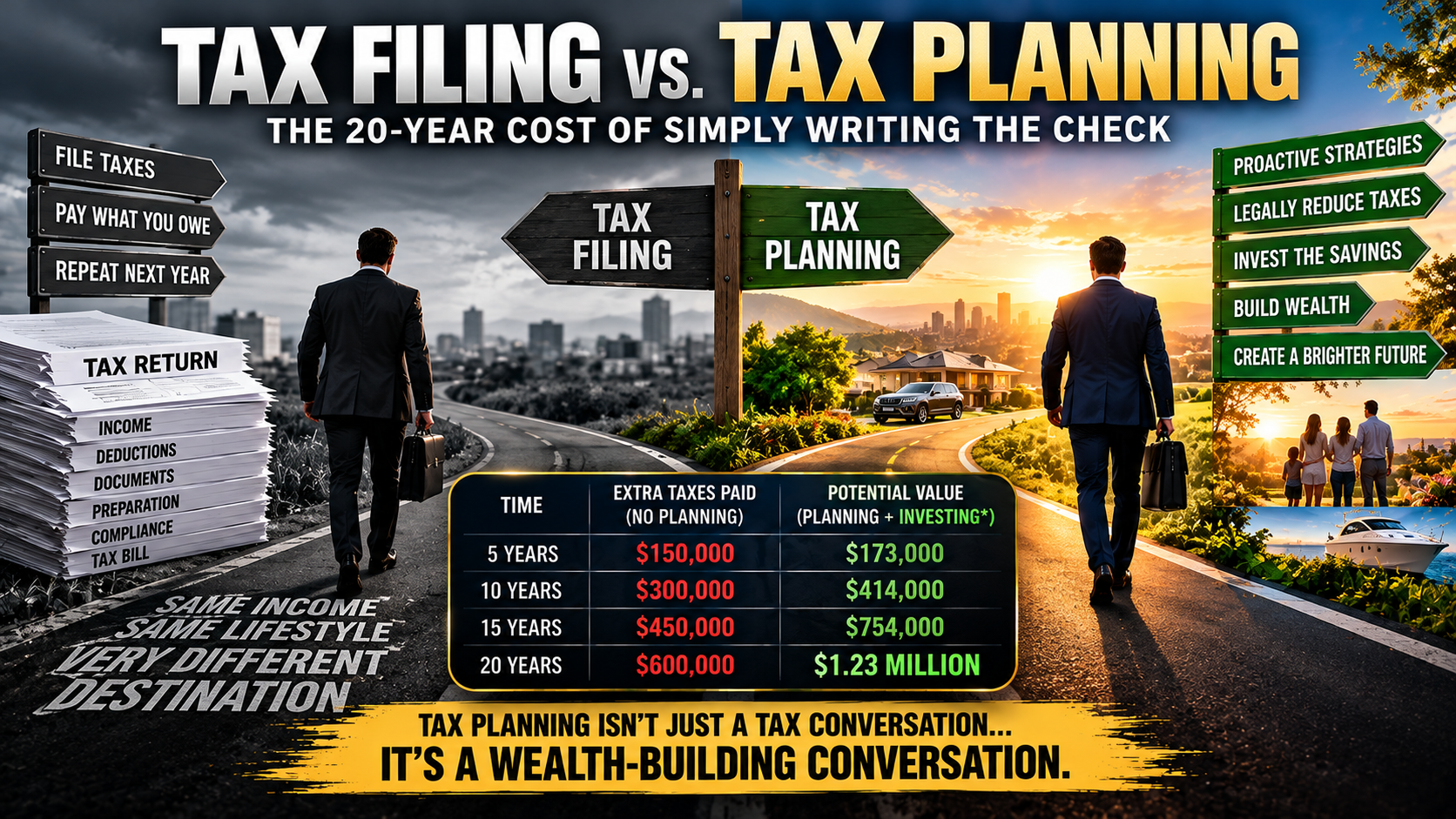
If Business Owner A continues paying an additional $30,000 every year, after five years that represents $150,000 of additional taxes paid.
If Business Owner B instead retained and invested $30,000 annually and hypothetically earned 7%, those dollars could grow to approximately $173,000 after five years.
After 10 years, Business Owner A would have paid an additional $300,000 in taxes. Business Owner B’s hypothetical investment account could be worth approximately $414,000.
At 15 years, the difference becomes even more significant. Business Owner A has paid an additional $450,000, while Business Owner B’s redirected capital could hypothetically have grown to approximately $754,000.
And after 20 years?
Business Owner A has paid an additional $600,000 in taxes.
Business Owner B, having redirected that same $30,000 annually and hypothetically earned 7%, could have accumulated approximately:
$1.23 Million
Same income. Same 20 years. Very different financial destination.
The Real Cost Isn’t Just the Tax
This is where tax planning stops being simply a tax conversation and becomes a wealth-building conversation.
When someone unnecessarily pays an additional dollar in taxes, the potential cost isn’t necessarily limited to that dollar. There is also an opportunity cost attached to what that money might have accomplished if it had remained under their control.
A dollar retained today could purchase an asset. That asset could appreciate or generate income. That income could be reinvested into additional assets. Those assets could eventually help create retirement income, business equity or an estate for the next generation.
Over decades, the difference can compound. That’s why looking only at this year’s tax bill can miss the bigger picture.
For business owners and high earners, another number deserves attention: What could your lifetime tax bill look like…and how much of it could potentially be reduced through legitimate proactive planning?
Tax Preparation Looks Back. Tax Planning Looks Forward.
Tax preparation generally focuses on something that has already happened. Income was earned. Expenses were incurred. Business decisions were made. Investments were bought or sold. The calendar year ended.
Now everything needs to be reported correctly. Tax planning asks questions before all of those decisions become history.
What strategies are available? How should the business be structured? Are there opportunities we’re not currently using? What needs to happen before year-end? How could certain decisions affect both today’s tax liability and tomorrow’s financial position?
That doesn’t make tax preparation less important. Ideally, tax preparation and proactive planning work together, with CPAs, tax professionals, attorneys and financial professionals contributing their expertise where appropriate.
The distinction is simply this: Tax preparation tells you what happened. Tax planning helps you make informed decisions about what happens next.
Pay What You Owe; But Why Voluntarily Pay More?
The objective of legitimate tax planning isn’t to hide income, manufacture deductions or avoid taxes that are legally owed.
You should pay every dollar you’re legally obligated to pay. But that leads to a very different question: Why would you voluntarily pay more than you’re legally required to pay?
And once legitimate tax savings are identified, there should be another question immediately behind it: What are we going to do with the money we keep?
Because finding tax savings isn’t necessarily the finish line. Putting those savings to work is where the larger opportunity may begin.
Imagine consistently redirecting money that otherwise would have been unnecessarily lost to taxes toward your business, investments, retirement, assets, family and legacy.
Doing it once may not dramatically change your financial life. Doing it consistently for 5, 10, 15, 20 or even 30 years can create a very different financial picture.
So if your current tax strategy consists primarily of gathering documents once a year and sending them to your preparer, perhaps it’s time to ask a different question:
Are You Simply Filing Your Taxes…or Do You Actually Have a Tax Plan?
The difference may seem relatively small in a single year. Over a lifetime, it could be a very different story.
If you’re a business owner or high-income household and would like to learn more about proactive tax-planning opportunities and how legally retained dollars can be redirected toward building your business, your assets and your financial future, contact us to learn more.
Schedule Time to Speak with Us: https://calendly.com/millionairemindsetlife/tax-mitigation-discovery-meeting
This article is for educational purposes only. Tax strategies and potential savings depend on individual circumstances and applicable law. The investment examples are hypothetical, assume annual contributions and a constant 7% return, and do not represent or guarantee actual investment results. Tax, legal and financial strategies should be reviewed with appropriately qualified professionals.
This article is for general educational purposes only and is not tax, legal, accounting, or investment advice. Strategies depend on individual circumstances and current law. Please review any strategy with your CPA, tax attorney, or other qualified professional before acting. Insurance products are subject to underwriting and carrier terms.